Showing posts with label Bugs. Show all posts

Sunday, August 28, 2011

Prayer service

I confess I let the vegetable garden get away from me. Not hard to do when you take vacation in August. I went out in my pajamas the other day to grab some tomatoes, and three hours later I was still weeding and trying to restore order. Still in my pajamas.

At one point I pulled a bunch of weeds and found a green bean in my hand. At least that was my initial thought, until it pinched me and I went "ack!" and flung it down.

She seemed none the worse for that, happily.

The freakiest thing about praying mantises is the human-like articulation of their heads. They turn their heads and look at you, and you just know they're wishing they were a little bit bigger or you a little bit smaller.

Sunday, August 07, 2011

Giant ichneumon wasp
(Megarhyssa macrurus)

I was digging up the irises around the birch stump today. We're going to have it ground down so we can plant another tree there. A long insect came zooming by and landed on the stump. I thought it was a dragonfly until I saw its tail.
My goodness! Is that a stinger? I grabbed my camera to take some photos. When the creature start to lift and flare its abdomen, I backed off, thinking that was some kind of threat display.

Then I went inside to look up what it was. What she was – a female Megarhyssa macrurus, or giant ichneumon wasp. What I thought was a stinger is really a 6-inch-long ovipositor. She was looking for holes bored by her rival, a pigeon horntail wasp.
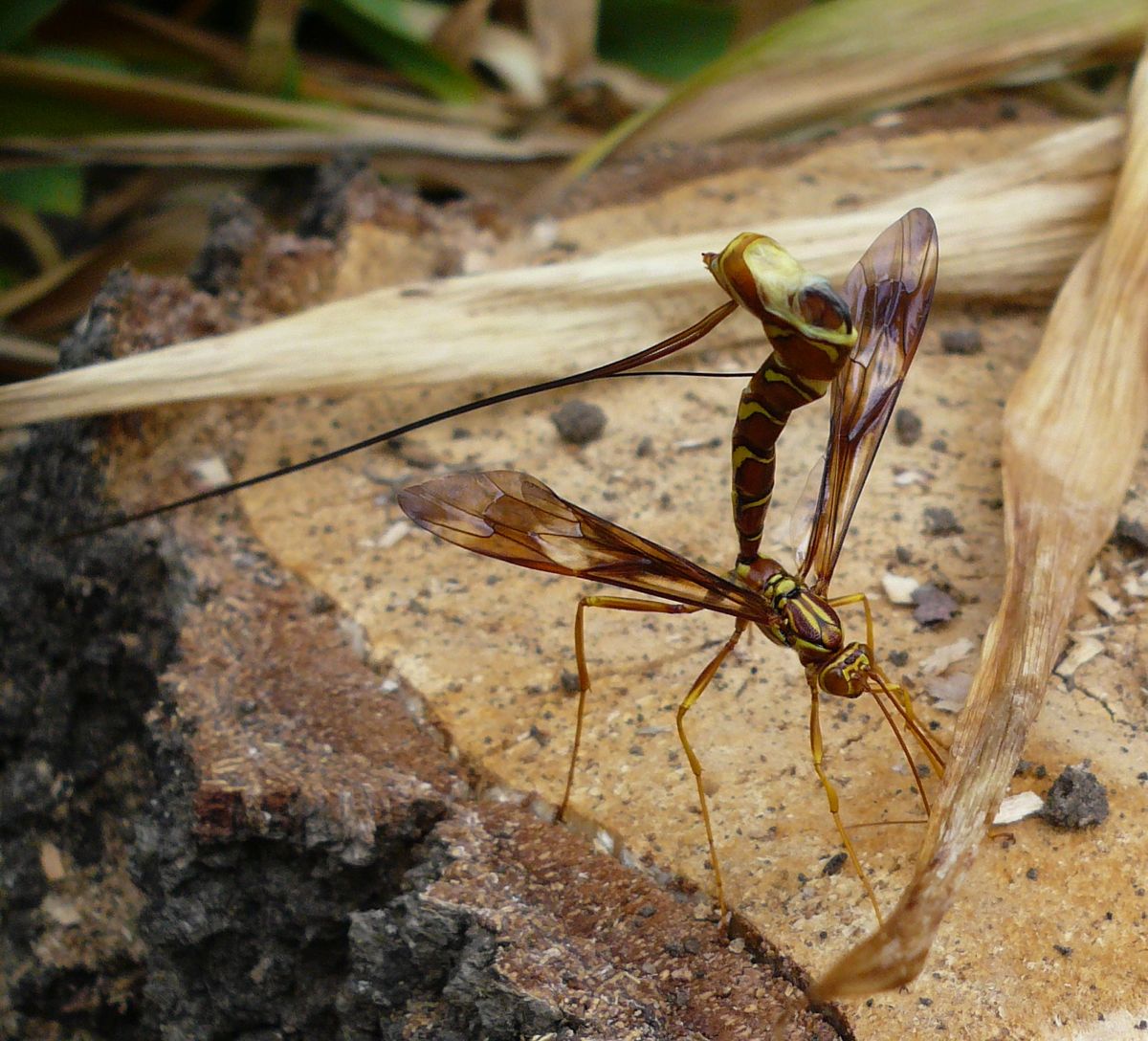
When she finds one, she lifts her abdomen high in the air and draws that long ovipositor forward until she can push it straight down into the hole, guiding it with her hind legs. In the hole is the larva of her rival, which she stings and paralyzes. Then she lays an egg, which will hatch and eat the paralyzed larva, then pupate and become an adult wasp the next spring.
Ew, right? But very interesting. It's so specifically evolved. (If you're not too squicked out, click to see the photos larger; they're pretty cool.)

It's funny, the Sergeant and I were discussing the theory of intelligent design and its flaws just last night. Turns out Darwin had something to say about that, involving the ichneumonidae's gruesome habits:
I own that I cannot see as plainly as others do, and as I should wish to do, evidence of design and beneficence on all sides of us. There seems to me too much misery in the world. I cannot persuade myself that a beneficent and omnipotent God would have designedly created the Ichneumonidae with the express intention of their feeding within the living bodies of Caterpillars, or that a cat should play with mice.
Thanks to the fine contributors to Wikipedia for expanding my insect horizons. And thanks to Ms. Wasp for stopping by. I'm sorry that your efforts will be in vain.

Sunday, July 24, 2011

Here there be dragons

I was sitting on the front steps this morning, waiting for a mouse to scamper by so I could get a picture, but those little buggers are fast.

Instead my patience was rewarded by a passing dragonfly.
He settled on faded iris stalk and posed with a saucy air.

"I'm ready for my close-up!"
Quite a different fellow from the blue beauty I captured three years ago (if you haven't seen that one, do take a look). As with the others, you can click on the photos to see them larger.

Saturday, July 23, 2011

Flutterby

This Western Tiger Swallowtail came flitting down to the echinacea in my front yard and obligingly posed for several dozen close-ups.
I was on the phone with Mom at the time (with a headset) and didn't notice until too late that the camera was on the wrong setting. So instead of a dozen awesome butterfly close-ups, I only have one OK shot. He or she took off just after.

Identification was easy because I remembered a similar butterfly on the Perennial Favorites website. Yep, it's the same one! You can click my photo to see it larger.

Another visitor to my front yard lately is a little brown mouse who has been busily harvesting the abundant seeds from all the flowers. He's too fast for photos but is surprisingly unconcerned about being seen otherwise. I just hope that he doesn't try to move indoors come fall.

Saturday, July 16, 2011

Not a bee

A while back, I posted about a bee imitator that I thought was a syrphid, or flower fly, but it turned out to be a wool carder. Yesterday I found an actual syrphid on my daisies.
Though it buzzes and hovers like a bee, it does not sting or bite. The bee-like markings also help fool predators. The larvae eat garden pests such as aphids.
This one has a vertical black stripe, which drew my attention, and it has a white face and big fly-eyes. There's a poster of some Syrphidae on Wikipedia that shows some of the many varieties.

My garden sure is pollinator central!

Friday, September 24, 2010

Going to seed

Lucy would like you to admire the ginormous sunflowers that the Sergeant planted. They are about 8 feet tall! He started them from seeds in mid-June. The bees love the blooms, aphids like the sap, and wasps like the aphids, so these are good flowers to encourage pollinators.

Unfortunately, too much encouraging of some pollinators leads to this:
I was wondering why I kept seeing wasps hovering outside the laundry room window. They can probably stay there, since they're out of the way. The first good freeze will kill the nest, and we'll knock it down this winter.

Monday, June 15, 2009

Imitation is not just flattery

Every time I stop to watch bees on flowers, I run into something else new. While the bees have so far been concentrating on the salvias and the bachelor buttons (Centaurea cyanus), they are now showing an interest in the newly blooming lamb's ears (Stachys byzantina):
As I was zooming in on the bees, I heard a different kind of buzzing and caught this fellow (or gal) hovering about:
Hmm. Looks and acts bee-ish – hovering, buzzing, feeding on nectar – but isn't. But also not a yellowjacket or wasp.

(Edit: I originally posted that this was a member of the Syrphid family, known as a flower fly or hover fly. But I was wrong, as a commenter pointed out. It's really a wool carder bee, a solitary member of the bee family.)
What was funny about this one, though, was that it had decided that the clump of lamb's ears was its exclusive territory. Every time a bee would come in for a taste, the fly would land on the bee and drive her off. That would happen too fast for me to get a photo, sorry!

But it didn't seem to mind me hovering around with my camera, and even set down for a portrait.
The lamb's ear makes for some very '70s upholstery, don't you think? And the bee looks to be wearing shades. Cool, man.

Wednesday, June 10, 2009

European paper wasp

I had left a small plastic pot overturned on top of small post next to the garden, and when I took it off a few days ago, I discovered this lady and her babies beneath it. (Click the photo to see her larger.)
She is a European paper wasp, a new and rapidly spreading arrival in Colorado (first spotted here in 2001). I found this out thanks to a helpful Colorado State University Extension fact sheet written by Whitney Cranshaw, the don of Colorado creepy-crawlies.

This fertilized queen spent the winter by herself in some sheltered spot, then started building her nest, making paper from wood that she had chewed to pulp. Her little colony will grow throughout the summer, then die off next fall, leaving behind a few more queens to start the process anew.

To give you an idea of her size, that post is just 1.5 inches square. I marked it with an arrow in the photo below. Please ignore the rest of the mess that is my garden.
I'm debating whether to let her stay there. Unlike yellowjackets (which look a lot like her, but fatter), she is not a scavenger, preferring to feast on caterpillars and other insects, many of them garden pests. But as her brood grows, I fear the wasplets may become more defensive of that space, which you can see is right next to the garden faucet. I also wonder if wasps eat honeybees.

I guess I'd better get more info and make a decision soon!

Friday, June 05, 2009

FOBs (Friends of Bees)

I felt lucky to capture a shot of this black-and-white bee, if only from the back. It turned out to be a plasterer bee (family Colletidae).

This mostly solitary bee is often only active for a few weeks each year. The female gathers pollen in a ball, places an egg on it and hides it in a burrow that she "plasters" with a special secretion. The secretion dries like cellophane and makes the burrow waterproof. The young bees eat the pollen and stay in the burrow over the winter, emerging in the spring as adults. Kind of a boring life, but it works! And they pollinate flowers along the way.

Another bee cousin is the bumble bee:
Bumble bees build colonies, too, but the hives are smaller (sometimes just 50 bees or so) and not nearly as well-organized. Bumble bees can also sting but rarely do so. I was chasing this gal all over trying to get a good shot.
I took it in the garden of the man who's responsible for the plant collections at the Denver Botanic Gardens. His place overlooks Denver from the east (if it weren't cloudy, you could see the mountains) and is a great example of turning an awkward blank slate of a yard into a showpiece. I'm taking notes!

Monday, June 01, 2009

Ladybug love

We knew about the birds and the bees. Now we know about the bugs, too.

Click on the photo to see it larger.

Saturday, November 01, 2008

Wolf spider

We went for little hike today outside Boulder with some friends. I need to sort through all my photos, but thought I'd toss up these two first.
Wolf spiders are said to be common in Colorado, but this is the first time I've seen one. That's my index finger to give you an idea of its size. (Click on the photos to see them larger.)

Wolf spiders don't build webs but roam around on the ground looking for prey. They are not aggressive but will bite if they feel threatened. The bite can be dangerous to a small child or old person, but it's not lethal, just nasty.
After we'd ooh'd and ah'd over this one, I nudged it off the trail with my foot so it wouldn't get stepped on.

I've been interested to see that my recent post on an orange arachnid has been hugely popular. There must be a lot of people out there trying to ID the eight-legged critters they see.

Tuesday, September 09, 2008

Big orange spider

"Look at that big spider!"

"What spider? Where? I don't see .... HOLY SHIT! That's a big spider!"
Vicki's post about her own mystery spider reminded me that the Sergeant spotted this humongous one on Sunday.
It's the biggest spider I've ever seen in Colorado (not including Rosie). Its body was maybe the size of a quarter. I guess I should have held a coin up to see.
I've been poking around online, and I think it might be an orb weaver. And maybe that's what all those baby spiders became. Do you know spiders enough to say?

Monday, September 01, 2008

They just won't quit bugging me

This is some kind of shield bug (I think), also known as a stink bug. He turned up on some sage I picked for roasting tomatoes. I didn't disturb him enough to make him stink, but took him outside and shook him off. If he is indeed a shield bug, he's not particularly bad for the garden, so that's OK.

Oh, and supposedly shield bugs are also edible. Should I have put him in the oven?

Let me know if I'm wrong on my ID! (You can click on the picture to see him bigger.)

Sunday, August 24, 2008

Bug-eyed

Do I attract interesting bugs or am I just really attuned to them?

No one could help but notice this fellow, seeing as how he was really large and bright green against my living room wall. He was at least three inches long.

He moved quite slowly, too, gingerly stepping one skinny leg at a time up the plaster, and not too concerned about my lens so close. Which was good, since the light was not great and I hate using flash in a situation like this. I didn't want to wash him out, and I was afraid it would frighten him off. I braced the camera against the wall and set it on a long exposure.

Click on any photo to see it larger.
After he meandered around for a bit, I put a plastic cup over him, slid some paper over the top and put him outside on the honeysuckle vine.
Do you know what kind of bug he is? He looks like a leaf-hopper on steroids.

Edit: Answered my own question by image-Googling "big green bug" and poking around a bit. He's a katydid. Sometimes called a long-horned grasshopper but more closely related to crickets. We have quite the chorus of them these days! They're not known to be particularly destructive in gardens, so I'm glad I didn't hurt him.

Monday, August 11, 2008

Mystery pest

These beetles were eating the shrubs outside Al Johnson's. They're pretty big, about the size of my pinkie fingernail.
I haven't seen them in Colorado, but maybe I haven't been looking, either.

Do you know what it is?

Monday, August 04, 2008

Sometimes beauty sneaks up on you

Who could this be, hiding behind an iris stalk?
A very obliging model.
Accustomed to being admired, perhaps.
Click the photos to make them larger. It's worth it.

Saturday, June 14, 2008

Not a hummingbird

This photo was taken 18(!) years ago outside my door in Beijing. I saw this huge crazy thing hovering around the flower pot, sipping nectar just like a hummingbird. I couldn't wrap my head around it. It must be a hummingbird! But it's not! It's a bug!

I later discovered that it is one of a group of moths known collectively (and aptly) as hummingbird moths.

I was just talking about them the other day with Susan, who hates moths but who decided she might be OK with these mini-hummers. They're good pollinators whose caterpillars do not destroy your garden.

Just as my interest in bees resulted in my suddenly seeing them everywhere, a hummingbird moth captured my attention at dusk last night, sipping from the honeysuckle.
I had to use the flash, but of course the one time the wings and lens aligned, the flash didn't pop.
If you played What Is It? a couple of days ago, you'll recognize this fellow (gal?) at rest on my front door screen. I didn't know then that it was a hummer. This particular kind is a striped morning sphinx moth.
If you spot moths in the kitchen or linen closet, you're right to do whatever it takes to eradicate them, but be nice to the hummingbird moth. It helps your garden grow.

Wednesday, March 19, 2008

More butterflies

This is the last batch of butterfly photos. The Butterfly Pavilion has a constant supply from all over the world. Every day more emerge and are released to flutter around the conservatory.
Such as this newly hatched one, which obligingly posed for photos on a curator's sleeve.
Here's another, fanned out on a leaf. I'm sorry I didn't get their names. I'll call this one Bob.
Bob decided to move to another leaf, invoking the wrath of ... George? Well, I don't know if was wrath, but George seemed pretty agitated, furiously fluttering as close as he could get without making contact. Or maybe Bob is really Roberta and George was making moves on her. Who knows?
Then there was this one, who seemed quite feminine. I'll call her Lucy. Pretty girl!
Finally, a butterfly whose motto is "Leaf me alone!" I'll call her Greta. She had the most impressive camouflage of all.
I guess this is a good post for the first day of spring, which here in the Mountain time zone starts at 11:48 tonight.

Happy spring!